Your Neighbours Got Approved: What the Planning Data Shows in NSW
Why do some developments sail through while others stall?
The answer: It's a combination of zoning alignment, application type, council resourcing, and how well the proposal fits the planning controls. Here's what the data actually shows about DA approvals in NSW, and what it means if you're planning your own project.
Zoning and Land Use Permissibility
The single biggest determinant of approval is whether the proposed use is permitted under the Local Environmental Plan (LEP). Every property in NSW sits within a zone—R2 Low Density Residential, R3 Medium Density, B2 Local Centre, and so on. Each zone has a schedule of permitted uses, prohibited uses, and uses that require consent.
If your neighbour built a dual occupancy and you're wondering why it was approved, the first place to look is the LEP. In R2 zones, dual occupancies are typically permitted with consent. In some R1 General Residential zones, they might be prohibited entirely.
The difference between "permitted" and "prohibited" isn't negotiable. Councils can't approve a prohibited use regardless of how good the design is or how much community support exists.
Development Type Matters
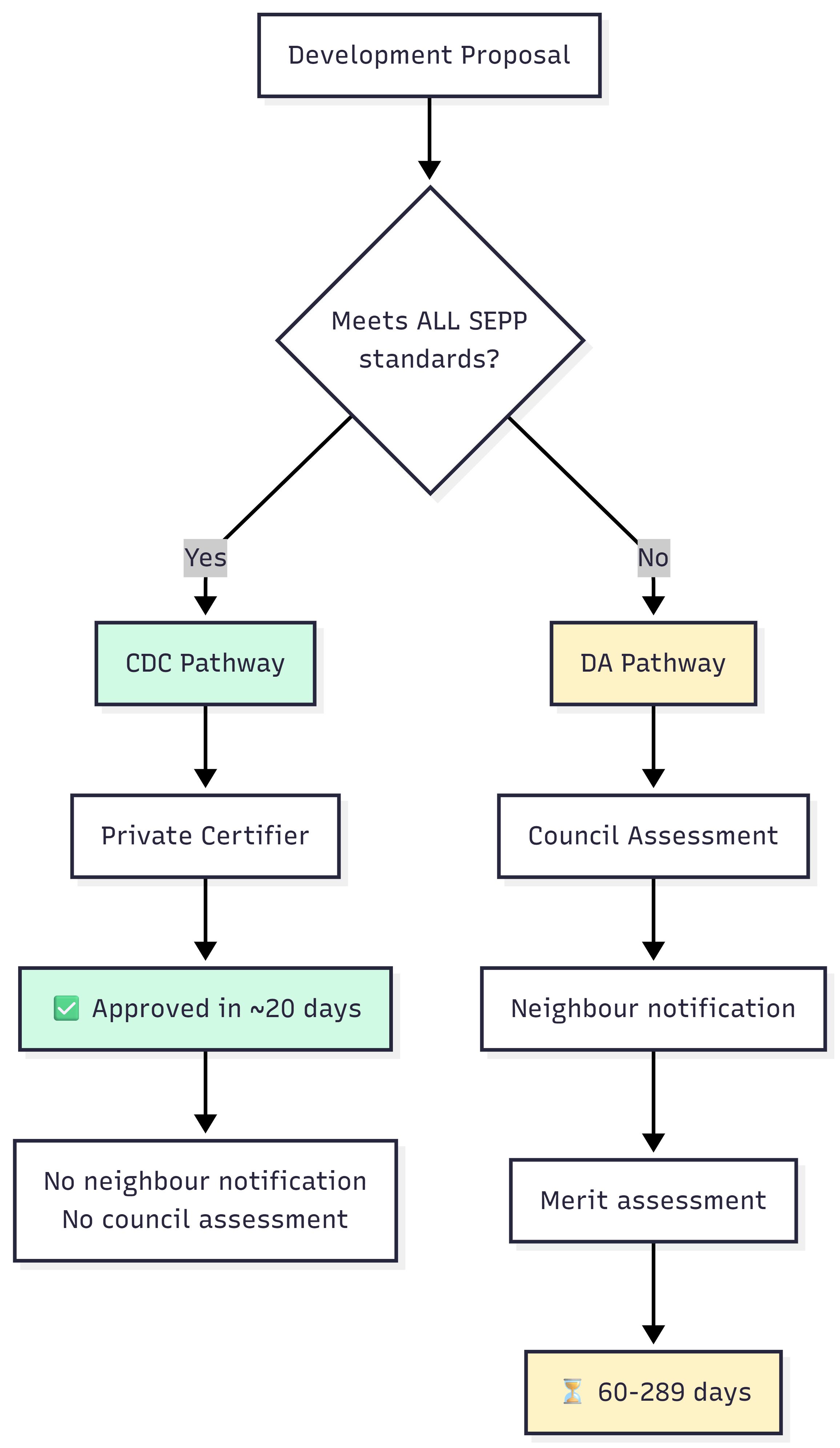
All approvals in NSW go through one of two possible streams: Development Applications (DAs), which councils assess and determine, and Complying Development Certificates (CDCs), which private certifiers can approve if the proposal meets predetermined standards.
CDCs are faster—often processed within 20 days—because they're essentially a compliance check. If the development meets every standard in the State Environmental Planning Policy (Exempt and Complying Development Codes), it gets approved. No neighbour notification, no merit assessment, no discretionary judgement. The NSW Planning Portal provides guidance on what neighbours are told about complying development—which is often very little.
If that dual occupancy next door went through as a CDC, the owners didn't need council approval at all. They just needed to prove compliance with the SEPP standards for setbacks, height, landscaping, and floor space ratio.
DA vs CDC: Two Different Pathways
No council assessment
This pathway difference explains why some developments appear to materialise overnight while others take months of council assessment.
NSW Development Approval Rates Explained
Understanding approval rates requires looking at both statewide trends and council-level variation. The differences are substantial.
Average DA Approval Rates in NSW (2024–2025)
For the period 1 July 2024 to 30 November 2024, NSW councils determined approximately 16,575 development applications, according to the NSW Planning Performance Dashboard. This volume tracks consistently with previous financial years, suggesting steady demand despite housing affordability pressures.
At a dwelling level, NSW contributed around 3,705 approved dwellings in October 2025 alone (seasonally adjusted), part of a national total of 15,832 dwelling approvals that month according to the ABS Building Approvals data. Over the past year to November 2025, NSW recorded more than 50,000 new housing approvals, with apartment approvals showing particularly strong growth—up approximately 49% year-on-year.
These figures indicate that developments are getting approved and that the challenge isn't approval rates per se—it's the time applications spend in assessment and the variance between councils.
Which Councils Approve Faster—and Why
The data gets interesting as assessment times across Greater Sydney councils range from 61 days (Wollondilly) to 289 days (Georges River). That's a difference of nearly eight months for what might be a comparable application.
The Property Council of Australia's 2025 analysis found that less than 25% of Greater Sydney councils met target timeframes for higher-density housing approvals. The average assessment time across Sydney sits at around 173 days—well above the NSW Government's benchmark of 105 days (reducing to 85 days by July 2027).
Why the disparity? Several factors:
Assessment resourcing: As would seem obvious, councils with larger planning teams relative to application volumes process faster. Under-resourced councils develop backlogs. The NSW Productivity & Equality Commission's 2024 review identified systemic bottlenecks in council assessment capacity as a key constraint on housing supply.
Application quality: Incomplete applications trigger requests for additional information, resetting assessment clocks. Councils report that poor-quality submissions are a leading cause of delays.
Complexity of controls: Some LGAs have more complex Development Control Plans (DCPs) with additional local provisions that require detailed assessment.
Political and community dynamics: Councils in areas with strong resident opposition to development may face more contested applications requiring panel determination or longer community consultation periods.
Approval Timeframes: How Long Councils Take
Understanding statutory and actual timeframes helps set realistic expectations for any development project.
Statutory Timeframes Under NSW Planning Law
The Environmental Planning and Assessment Act sets baseline timeframes for DA assessment:
- 40 days for applications not requiring referral or public notification
- 60 days for applications requiring notification
- 90 days for designated development or applications requiring concurrence from state agencies
These are "deemed refusal" periods—after which an applicant can appeal to the Land and Environment Court if no determination has been made. They're not guarantees of decision timing.
For CDCs, the timeframe is 20 days from lodgement of a complete application.
Real-World Assessment Times by Council
The NSW Planning Performance Dashboard publishes actual assessment times by council. As of late 2025, the statewide average sits around 83 days—technically meeting the current 105-day target. But this average masks significant variation.
Fast performers:
- Wollondilly: ~61 days average
- Several regional councils: 50–70 days
Slow performers:
- Georges River: ~289 days average
- Several inner-city councils: 150–200+ days
Reports indicate thousands of DAs pending across Sydney councils, with some applications exceeding 12 months in assessment. If your neighbour's approval came through quickly, they may have lodged in a council with better resourcing—or submitted a higher-quality application that didn't require back-and-forth.
Common Reasons Neighbour DAs Succeed
When you dig into approved applications, patterns emerge. Successful DAs typically share several characteristics:
Pre-lodgement advice followed: Many councils offer pre-DA meetings where planners flag potential issues before formal lodgement. Applicants who act on this advice avoid common refusal triggers.
Controls complied with exactly: Applications that meet numerical standards—height limits, floor space ratios, setbacks, landscaping areas—face fewer grounds for refusal. Variations require justification and invite discretionary assessment.
Complete documentation: Missing reports, inadequate plans, or absent owner's consent forms trigger information requests that delay assessment. Clean applications progress faster.
No unresolved neighbour objections: While councils aren't bound by objection numbers, contentious applications often require more detailed assessment or determination by elected councillors rather than delegated staff.
Non-discretionary standards met: Some controls are "non-discretionary"—if you meet them, the council must approve regardless of other factors. Understanding which standards carry this weight is valuable. The recent Transport Orientated Development provisions encouraging development near transport corridors are in this category.
How to Check If Your Property Is Comparable
Seeing a neighbour's approval doesn't automatically mean yours will follow. But it does provide useful intelligence.
Finding Nearby Approved DAs
Every council maintains a DA tracking system where you can search approved applications by address or suburb. These records typically include:
- The original plans and documentation
- Any submissions received during notification
- The assessment report
- Conditions of consent
Reviewing nearby approvals shows you what councils have accepted in your area—setback treatments, height approaches, design responses to site constraints.
The NSW Planning Portal also aggregates DA data across councils, though detail levels vary.
Comparing Controls: Height, FSR, Setbacks
When comparing your site to an approved neighbour development, focus on the planning controls that apply to each lot:
Height: Maximum building height is set in the LEP. Two adjacent lots in different zones may have different height limits.
Floor Space Ratio (FSR): This controls bulk and scale. An approved development next door may have a higher FSR allowance than your lot.
Setbacks: DCP setbacks can vary by zone, lot size, or even street frontage. Check whether the same setback provisions apply.
Heritage or conservation overlays: Your lot may have constraints the neighbour's doesn't.
The key is comparing like with like. An approval on a 1,000sqm lot in R3 zoning tells you little about prospects for a 500sqm lot in R2 zoning—even if they're adjacent.
What Neighbour Approvals Mean for Your Own Application
Past approvals provide context, but they're not precedent in the legal sense.
When Past Approvals Are Relevant
Nearby approvals matter when:
- They demonstrate how councils interpret ambiguous controls in your area
- They show accepted design responses to common site constraints (slope, orientation, neighbouring buildings)
- They establish a streetscape character that your proposal should respond to
Planners will consider the existing and likely future character of an area. If several dual occupancies have been approved on your street, it suggests council sees that built form as appropriate for the location.
When Councils Can Ignore Precedent
Unlike court decisions, council approvals don't bind future decisions. Each DA is assessed on its merits against current controls. Councils can—and do—refuse applications that resemble previously approved ones if:
- Controls have changed since the earlier approval
- The earlier approval was incorrectly granted
- Site-specific differences justify a different outcome
- The cumulative impact of multiple similar developments is now a concern
This cuts both ways. A neighbour's refusal doesn't doom your application either.
Making Sense of the Approval Landscape
The NSW planning system processes tens of thousands of applications annually, with approval volumes tracking housing policy targets in aggregate. But the experience at individual council level varies enormously—from efficient 60-day turnarounds to year-long waits.
If you're researching development potential for your property, understanding what's been approved nearby is a logical starting point. It reveals how councils apply controls in practice, what design approaches work, and whether your concept aligns with established patterns.
The data exists—in council DA trackers, the NSW Planning Performance Dashboard, and aggregated approval databases. The challenge is making it accessible and comparable.
PlotDetect's free MapViewer lets you look up any NSW property to see surrounding Approved DA's and CDC's, zoning, height limits, and FSR, (as well as many other critical layers) — the same controls you'd need to benchmark against a neighbour's approved development. For tracking approval trends across councils and postcodes, ChartViewer turns scattered planning data into searchable intelligence.
Data sources: NSW Planning Performance Dashboard, Australian Bureau of Statistics Building Approvals (October 2025), Property Council of Australia, NSW Productivity & Equality Commission.