What Gets Objected To in Development Applications? Insights from 10,000 DAs
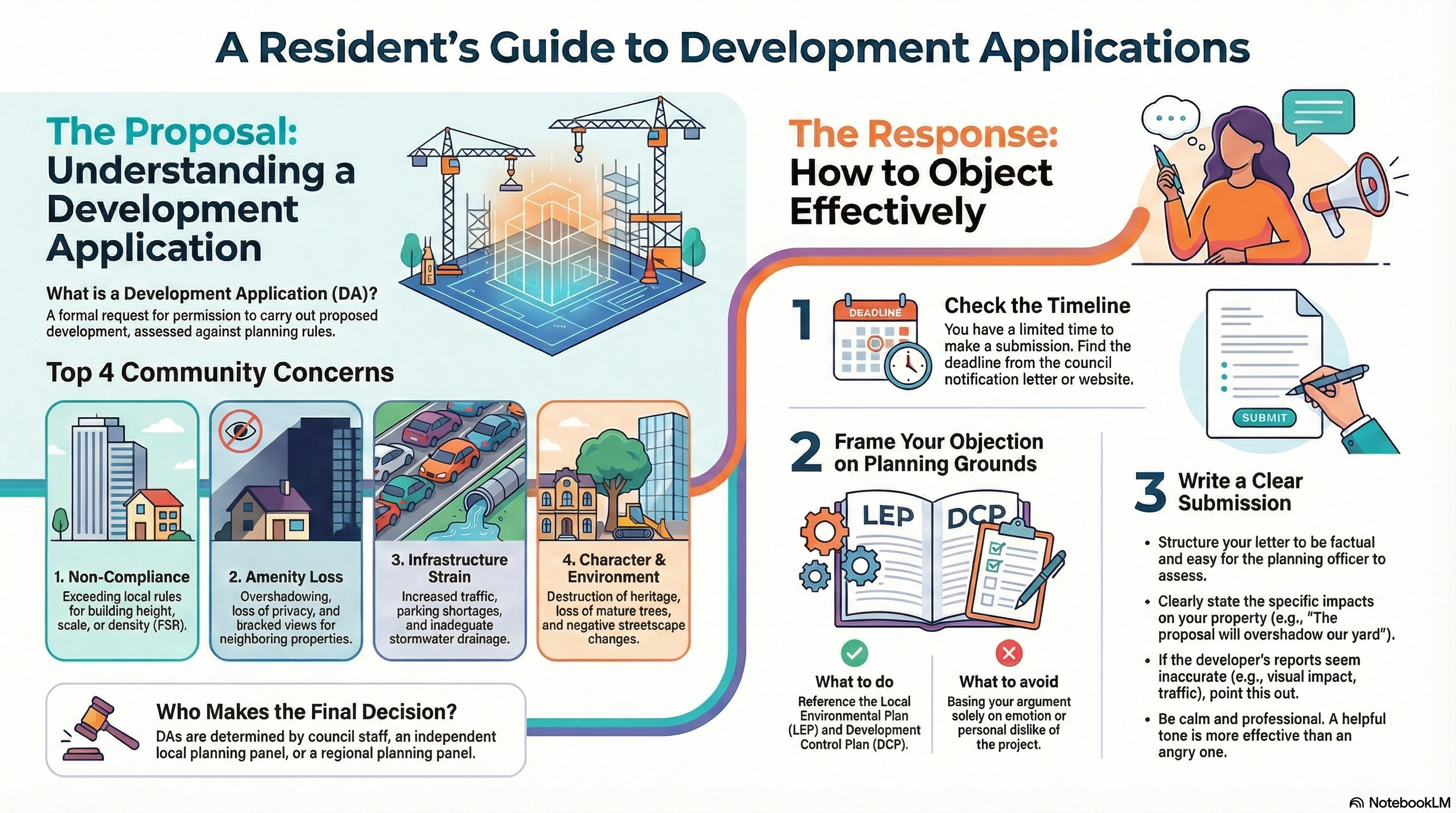
If you've ever lodged a development application in NSW, you know the feeling: weeks of preparation, thousands in consultant fees, and then you wait. Sometimes approvals sail through. Other times, a handful of neighbour objections derails months of planning.
But here's what most applicants never see: the patterns. After analysing over 10,000 development applications across NSW councils, clear trends emerge about what triggers objections, which ones councils actually weight in their decisions, and—perhaps most usefully—which proposals attract disproportionate community resistance.
This isn't a guide on how to object to your neighbour's granny flat. It's a data-informed look at what gets flagged, why it matters, and how to anticipate problems before you lodge.
What Is a Development Application Objection?
When a DA is notified to neighbours and the public, anyone can submit comments or formal objections. These submissions become part of the assessment record. Council planners must address them in their reports—but not all objections carry equal weight.
What counts as a "material planning consideration" in NSW?
Under the Environmental Planning and Assessment Act 1979, councils assess DAs against statutory criteria: compliance with Local Environmental Plans (LEPs), Development Control Plans (DCPs), and broader planning principles. Objections that relate to these criteria—amenity impacts, environmental harm, traffic safety—are "material" and must be genuinely considered.
Objections about loss of private views, reduced property values, or personal disputes with an applicant? These are explicitly excluded from planning consideration in most Australian planning systems, including NSW.
Material vs Non-Material Objections
The distinction matters. A well-evidenced objection about overshadowing has statutory teeth. A complaint about neighbourhood change, however heartfelt, typically doesn't.
The Ten Most Common Development Application Objections
Based on council assessment reports, planning tribunal decisions, and practitioner experience, the following categories account for the vast majority of DA objections in NSW.
1. Overshadowing and loss of sunlight
Solar access is protected under most DCPs, with specific requirements for how much sunlight private open space and living areas must retain. Objections citing shadow diagrams or winter solstice impacts are common—and often persuasive when the numbers don't stack up. Amenity impacts like overshadowing are among the most frequently cited grounds.
2. Privacy and overlooking impacts
Windows, balconies, and rooftop terraces that overlook neighbouring properties generate predictable objections. DCPs typically mandate screening, setbacks, or obscured glazing, and non-compliance here is straightforward for councils to assess. Community discussions in NSW frequently cite privacy as a primary concern.
3. Building height, bulk, and scale
"It's too big" is the most common instinctive objection, but it only gains traction when proposals breach height limits or floor space ratios. More nuanced objections focus on building envelope controls, setbacks, and the relationship to neighbouring dwellings. Visual coherence and character remain central to local planning schemes.
4. Traffic generation and parking shortfalls
Councils require traffic impact assessments for larger developments, and neighbours frequently object to increased vehicle movements, inadequate on-site parking, or unsafe access arrangements. Traffic and access concerns are material planning considerations that often result in objections.
5. Noise impacts (construction and ongoing)
Both construction-phase noise and operational noise (think air conditioning units, commercial uses, or multi-dwelling common areas) attract objections. Acoustic reports are now standard for many DA types, but disputes over predicted versus actual noise remain common.
6. Streetscape and neighbourhood character
This is where subjective and objective concerns collide. Objectors often describe proposals as "out of character" or "inconsistent with the streetscape." Councils assess these claims against specific DCP controls for materials, setbacks, roof forms, and articulation. Vague character objections rarely succeed; specific breaches of design controls sometimes do.
7. Environmental impacts (trees, drainage, flooding)
Tree removal, stormwater management, and flood risk are increasingly contentious. Many councils now require arborist reports, biodiversity assessments, or flood studies. Environmental harm is both a statutory assessment trigger and a community priority in objections.
8. Heritage and conservation area impacts
Proposals affecting heritage items or within heritage conservation areas face additional scrutiny. Heritage considerations are specifically flagged in many councils' assessment criteria, and objections citing heritage impact are taken seriously.
9. Non-compliance with LEP or DCP controls
The most technically robust objections identify specific control breaches: a setback that's 200mm short, a floor space ratio that exceeds the limit, or a land use that's prohibited in the zone. Legal compliance forms a basis for professional objections and appeals.
10. Construction access and site management
Concerns about construction vehicle access, site fencing, dust, and hours of work are common but rarely determinative. Councils typically address these through conditions of consent rather than refusal.
Which Objections Actually Influence Council Decisions?
Not all objections are created equal. Understanding which ones councils must legally consider—and which they routinely set aside—can save applicants significant time and cost.
Objections councils must legally consider
Any objection relating to a statutory planning control or environmental impact requires a formal response in the assessment report. This includes amenity impacts (overshadowing, privacy, bulk), traffic and parking, environmental harm, heritage, and compliance with LEP and DCP standards. NSW councils' objection guidelines emphasise adverse impacts on local amenity, environmental concerns, and traffic and safety issues.
Common objections that are usually disregarded
Loss of private views (as distinct from outlook), reduction in property value, competition with existing businesses, personal grievances, and objections based purely on opposition to change carry no statutory weight. Councils acknowledge these submissions but are not required to treat them as material considerations.
NSW-Specific Objection Patterns (2024–2025)
Urban infill and density-related objections
State government targets for housing supply have accelerated medium-density approvals in established suburbs. Dual occupancies, manor houses, and multi-dwelling housing consistently attract objections focused on character, parking, and cumulative neighbourhood change. NIMBY-related resistance to infill and higher-density proposals remains salient in well-established urban areas.
Suburban character and solar access disputes
In low-density residential zones, solar access remains the single most contested issue. DCPs in many Sydney councils specify minimum hours of sunlight for neighbouring properties, and applicants who fail to demonstrate compliance face both objections and refusal risk.
Environmental risk objections (flooding, bushfire, trees)
Post-2022 flood events in NSW have heightened community and council sensitivity to stormwater and flood planning. Tree preservation orders and biodiversity offsets also attract increasing scrutiny. Objections grounded in environmental risk are more likely to trigger specialist referrals and extended assessment timeframes.
Do Objections Actually Change DA Outcomes?
This is the question most applicants want answered: does community opposition actually matter?
The evidence is mixed. Research on third-party objections in Australian planning shows that a single, well-reasoned objection identifying a clear DCP breach can trigger a request for amended plans or, in some cases, refusal. Conversely, dozens of objections that amount to generalised opposition rarely shift outcomes where a proposal is technically compliant.
Objections linked to refusals
Refusals are most likely when objections align with genuine non-compliance—particularly where proposals exceed height, FSR, or setback controls, or where environmental or heritage impacts cannot be adequately mitigated.
Objections leading to modified conditions
More commonly, objections result in additional conditions of consent: screening to address privacy, amended landscaping, or restrictions on construction hours. These conditions may not satisfy objectors but allow councils to approve compliant proposals while addressing specific concerns.
When objections have no material impact
Where a proposal complies with all applicable controls, objections—even numerous ones—rarely prevent approval. Councils are bound by planning law, not community sentiment.
How to Anticipate Objections Before Lodging a DA
The smartest applicants don't wait for objections; they design around them.
Use nearby approvals and refusals as a guide
Reviewing how similar proposals in the same street or suburb were assessed reveals what councils—and neighbours—focus on. If three nearby DAs were modified to address overshadowing, expect the same scrutiny.
Compare proposal metrics to council benchmarks
DCPs publish the numbers that matter: setbacks, height limits, parking rates, solar access requirements. Proposals that sit comfortably within these benchmarks attract fewer objections and faster approvals.
Learn from neighbour objections on similar sites
Where objection submissions are publicly accessible, patterns emerge. Some streets have organised resident groups; some councils have assessment officers with particular sensitivities. Local knowledge matters.
If you're planning a DA and want to understand what's been approved nearby, how your council is tracking, or what DCP controls actually apply to your site, PlotDetect can help. MapViewer lets you see DA history for any of 3.5 million NSW properties. ChartViewer tracks DA and CDC activity across all NSW councils. The Compliance Engine indexes 48,000 DCP provisions searchable by zone and development type.